In Defence of the Black Bloc
Responding to Omar Hassan’s “Police Are Getting More Violent, But Black Bloc Tactics Make Things Worse”
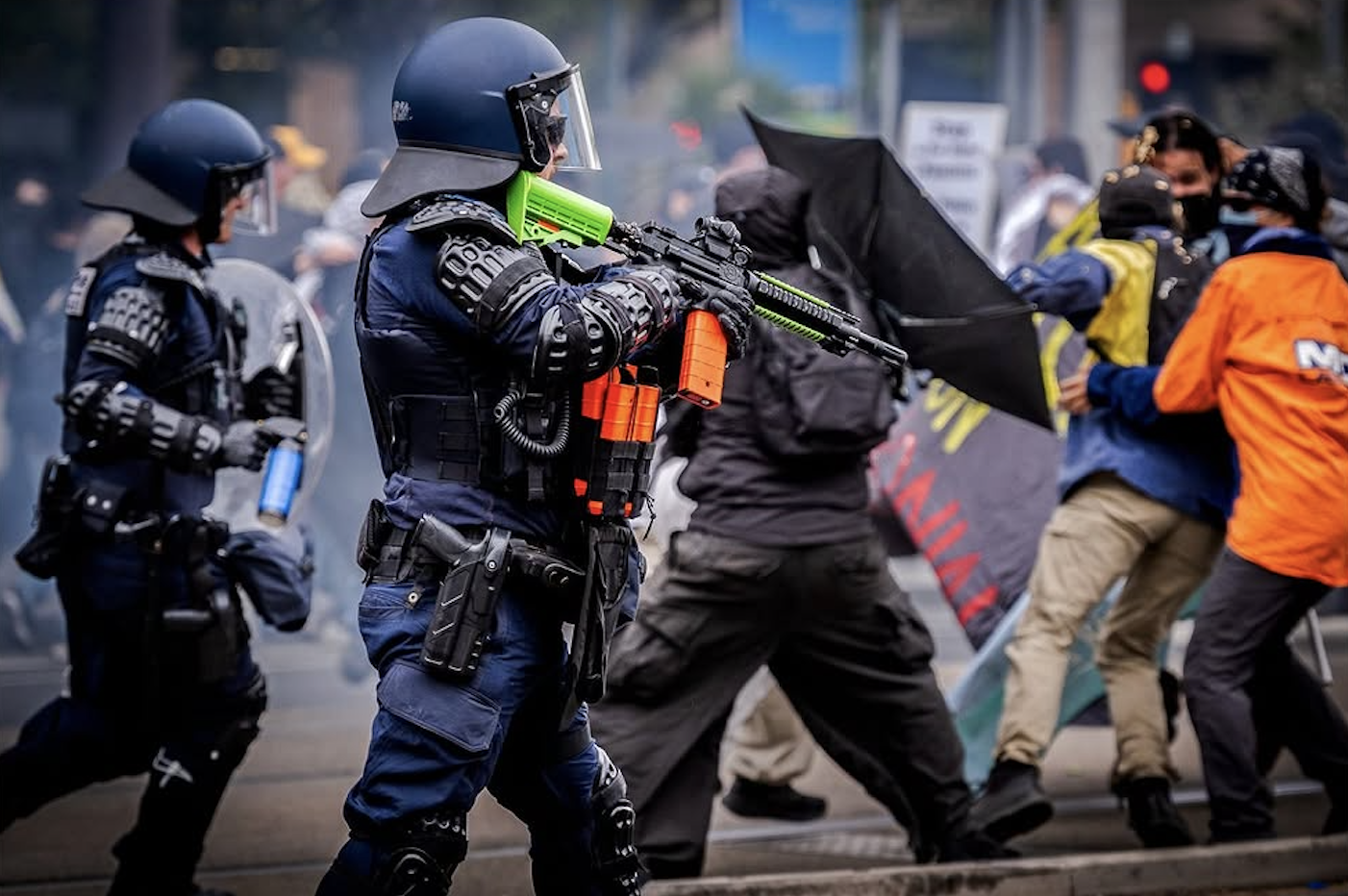
Photograph by Sydney Low
Police militarisation is entrenched in Naarm, part of an intensifying global condition. Protest is managed through a hardened repertoire of force and surveillance, deployed pre-emptively rather than exceptionally. Escalation has tightened into a loop in which police tactics and protester adaptations continually condition each other. This is the context in which Hassan’s argument about “defensible tactics” and movement-building has to be judged.
Before responding, it is worth stating Omar Hassan’s argument clearly. He describes escalating police violence and insists it poses a serious threat to organising. His strategic claim is that movements grow by making actions meaningful to participants while also remaining defensible to broader layers of sympathisers who are not yet committed. On this view, tactics that appear unreasonable, or that reliably produce chaotic scenes and police violence, raise the cost of participation, reduce turnout, hand the media a predictable law-and-order frame, and offer the state justification for new restrictions. This is the centre of his critique of the black bloc: that it turns protest into “street theatre,” imposes risk on others without consent, and weakens the capacity to build the mass movement required to confront both capitalism and the far right. These are serious concerns. But the framework that organises them—conduct, optics, and defensibility—misdescribes the conditions in which protest now takes place in Naarm.
Recent media tours of Victoria Police’s Regional Operations Centre make the architecture explicit. From a central “mission control” room, senior command watch a wall of live feeds: Melbourne City Council CCTV, police drones overhead, intelligence officers filming on the ground. A map of the CBD is annotated with markers representing units and key locations. Protesters appear as moving dots on a screen. Cameras can be swung and zoomed within seconds to focus on any given corner. Still images of faces are captured and passed to an investigations “cell,” who track people back through hours of footage to when they arrived unmasked. Masked participants from a previous protest are described as already “tracked and identified” from earlier in the day. Protest in Naarm is governed through an integrated, real-time visual grid enabling retrospective identification and targeted pursuit. This neo-panopticon does not replace the physical nature of state violence. It operates atop it, amplifying the reach of batons, shields, and chemical weapons with a digital layer of surveillance that extends coercion beyond the immediate encounter.
This architecture is being codified as policy. From late 2025 through mid-2026, Victoria Police declared a vast inner-city “designated area” across the Melbourne CBD and surrounds, granting officers expanded powers to stop and search people and vehicles without warrant or reasonable suspicion, and to compel the removal of face coverings. Civil society groups have warned that such discretionary powers predictably intensify targeting of people already exposed to policing: racialised communities, unhoused people, young people, and others whose vulnerability is routinely treated as suspicion. These measures formalise a policing logic that treats visibility as a condition of legitimacy and anonymity as deviance.
This is the first point at which Hassan’s analysis falters. Not because he denies repression, but because his strategic reasoning treats repression primarily as a variable cost that movements can raise or lower through defensible presentation. That is only partly true. Repression is not simply the contingent response to protester excess. It is an apparatus that organises bodies, vision, movement, and political legibility in advance. Protest does not occur in neutral space into which police step only when provoked. It occurs inside an already-designed field of surveillance, containment, and control. Protesters and police co-produce the scene of struggle, but only one actor holds a monopoly on force, control of infrastructure, and the authority to define what counts as order.
Repression also functions dialectically. It produces submission and resistance, fear and defiance, closure and possibility. It shapes the ecology of dissent: how movements organise, how solidarity is built, and how collective risk is distributed across different bodies in the street. A politics that focuses mainly on optics risks collapsing this complex relation into a behavioural parable. If tactics are reasonable, repression becomes politically costly. If tactics are unreasonable, repression becomes justified. That parable tracks too closely with the state’s preferred moral narrative, even when advanced in the name of movement growth.
This brings us to the black bloc. Hassan treats it as a coherent ideological tendency—a distinct contingent whose anonymity is oriented toward violence and which then harms the broader movement. But in Naarm’s present conditions, “black bloc” functions less as an ideology than as a relational formation produced within the encounter between protest and policing.
“Black bloc” is not one thing. It is a name that gets attached—by police, media, organisers, and participants—to a shifting set of relations in the street: visibility and anonymity, cohesion and dispersion, defence and exposure, escalation and containment. What gets called “bloc” is produced in real time by what police are equipped and authorised to do, by how crowds move, by who is targeted, by what media select as the scene, and by the anticipations that circulate through a demonstration.
This matters because the ethical and strategic question is not “bloc or not.” It is how anonymity, discipline, and mutual protection are organised under conditions of surveillance and pre-emptive violence—and how, within that same field, actions can become unaccountable, isolating, or spectacular in ways that fracture trust and redistribute risk. Hassan’s critique gains traction where it names those fractures. Where it fails is in treating “the bloc” as a coherent actor with a single orientation, rather than as a contingent formation shaped by the apparatus it confronts.
Under these conditions—neo-panoptical surveillance, indiscriminate violence and police militarisation, and expanding powers that enable discretionary targeting—anonymity isn’t an aesthetic. It is a baseline of political self-defence.
Hassan’s account also tends to reverse causality. He argues, in effect, that bloc presence generates scenes of violence that then justify repression and deter participation. But in Naarm, bloc formations often arise because violence and surveillance already enforce narrow boundaries around acceptable dissent, reduce protest to sanctioned parades, and punish those who step outside those containments. It is true that confrontations can feed a further spiral. They can also become the occasion for repression and its headlines—but that does not make them the source of the repressive logic. The apparatus is built to convert any rupture into justification.
There have been repeated instances where peaceful, unmasked protest lines have been kettled, struck, sprayed, or charged without any bloc formation present. Protesters of all kinds have experienced excessive violence and intimidation: officers obscuring badge numbers, indiscriminate use of force, verbal abuse, and systematic face capture through cameras and drones that feed what functions as a policing databank for managing dissent. These practices show that the underlying logic of repression does not depend on a bloc. It is grounded in suspicion, containment, and the production of fear. Under such conditions, tactics that prioritise safety, solidarity, and anonymity are not fringe. They are structurally necessary.
This is where the “parasitism” claim becomes especially unstable. Hassan suggests that bloc formations rely on broader crowds as cover and impose consequences on others who did not agree to the tactic. The consent critique here is real and must be taken seriously. Movements cannot treat participants as shields. They cannot impose unchosen risk and then call it solidarity. Any tactic that predictably draws violent response raises ethical questions about accountability, preparedness, and collective decision-making.
But these problems do not entail Hassan’s conclusion: expulsion. The relevant distinction is not bloc versus non-bloc. It is accountable defence versus unaccountable escalation. If a movement is serious about both growth and protection, the task is to develop shared ways to deliberate risk and consent—strengthening protective anonymity and collective safety while refusing escalation that uses others as cover. Blanket bans function as moral purification rather than strategy. They strip away defensive capacity and redistribute risk onto the most visible and precarious participants, while leaving the policing apparatus intact.
This clarifies what is at stake in Hassan’s appeal to “defensibility.” Defensibility is not neutral. It is tethered to legibility and respectability, and to the optics of the “good protester” who remains identifiable, predictable, and willing to trust police to honour the choreography. In a policing environment that openly expands warrantless search powers and compels the removal of face coverings, defensibility collapses into a demand for legibility on terms set by the state. Respectability politics isolates militants, legitimises repression, and keeps dissent within governable aesthetic boundaries. It recasts protest as civic ritual rather than a disruption of order. Movements require protection, not obedience to the state’s preferred optics.
Hassan’s broader political claim—that only mass, working-class movements can effectively challenge the far right—need not be rejected to defend bloc tactics. The dispute is not mass politics versus militancy, as if one must be expelled for the other to live. History suggests tension and interplay: disciplined organising expands capacity; refusal and defiance test boundaries; repression attempts to close space; movements adapt. None of this requires romanticising confrontation. It requires recognising that political space is contested and that defensive tactics often emerge where the state makes ordinary participation dangerous.
The key question, then, is not whether the black bloc is “good.” It is why bloc formations become necessary. In Naarm’s policing landscape, they emerge from structural conditions: surveillance architectures, criminalisation patterns, and the state’s intensified reliance on coercive force as governance. To meaningfully reduce the need for bloc tactics would require dismantling the apparatuses that generate them—integrated CCTV and drone surveillance, data and image tracking, riot-control doctrine, and the normalisation of violence against dissent. Until then, condemning protective anonymity as parasitism misidentifies the problem.
Hassan’s analysis remains largely at the level of conduct and optics. A politics capable of confronting contemporary repression must go deeper: into architecture, into the co-production of repression and resistance, into how risk is distributed, and into how movements protect people while building capacity. Only there can questions of tactics, strategy, and solidarity be posed in a way that fits the world in which they are forced to operate.